

Tires are the single largest variable maintenance cost on a Class 8 truck — and the one area where a structured program consistently delivers a 25 to 40 percent reduction in total cost compared to reactive replacement. Most owner-operators and small fleets manage tires the same way: replace when tread is gone or a blowout forces the issue. That approach is expensive, unpredictable, and avoidable. A disciplined rotation schedule, a three-point tread measurement standard at every PM interval, and alignment checks on the 80,000-mile window close the gap between what most operators spend on tires and what they need to spend.
- Measure tread at inner shoulder, center rib, and outer shoulder at every PM; record readings by tire position.
- Check tire inflation at every pre-trip using cold PSI as baseline; avoid hot readings for pressure setting.
- Perform professional alignment checks at about 80,000 miles and after impacts; prioritize steer axle adjustments.
- Combine tire rotation with PM-A or PM-B services every 25,000 to 35,000 miles to balance wear and protect casings.
- Inspect pulled tires for retread eligibility; retreading preserves casing value and reduces replacement cost.
Why Tire Management Fails in Small Fleets
The failure mode in most small fleet and owner-operator tire programs is measurement. Without a three-point tread depth measurement recorded at every PM service — inner shoulder, center rib, outer shoulder — irregular wear patterns are invisible until the damage is done. A tire showing 8/32″ at the center rib can simultaneously show 3/32″ at the inner shoulder if it has been running underinflated or on a misaligned axle. That tire has not reached its service life in any meaningful sense — it has been prematurely killed. According to Heavy Vehicle Inspection’s commercial tire maintenance analysis, fleets that implement consistent three-point measurement programs extend average tire life by up to 25% compared to center-only measurement practices.
The second failure mode is inflation discipline. Rush Truck Centers’ best practices guide documents that a Class 8 steer tire running 10 PSI low loses approximately 12,000 miles of service life per set — roughly $400 to $600 per tire in premature wear cost. Across an 18-wheel configuration, systematic underinflation can generate $3,000 to $5,000 annually in accelerated tire replacement costs without a single visible blowout to flag the problem. Tire pressure checks belong at every pre-trip, not at every fuel stop when the driver happens to think about it.
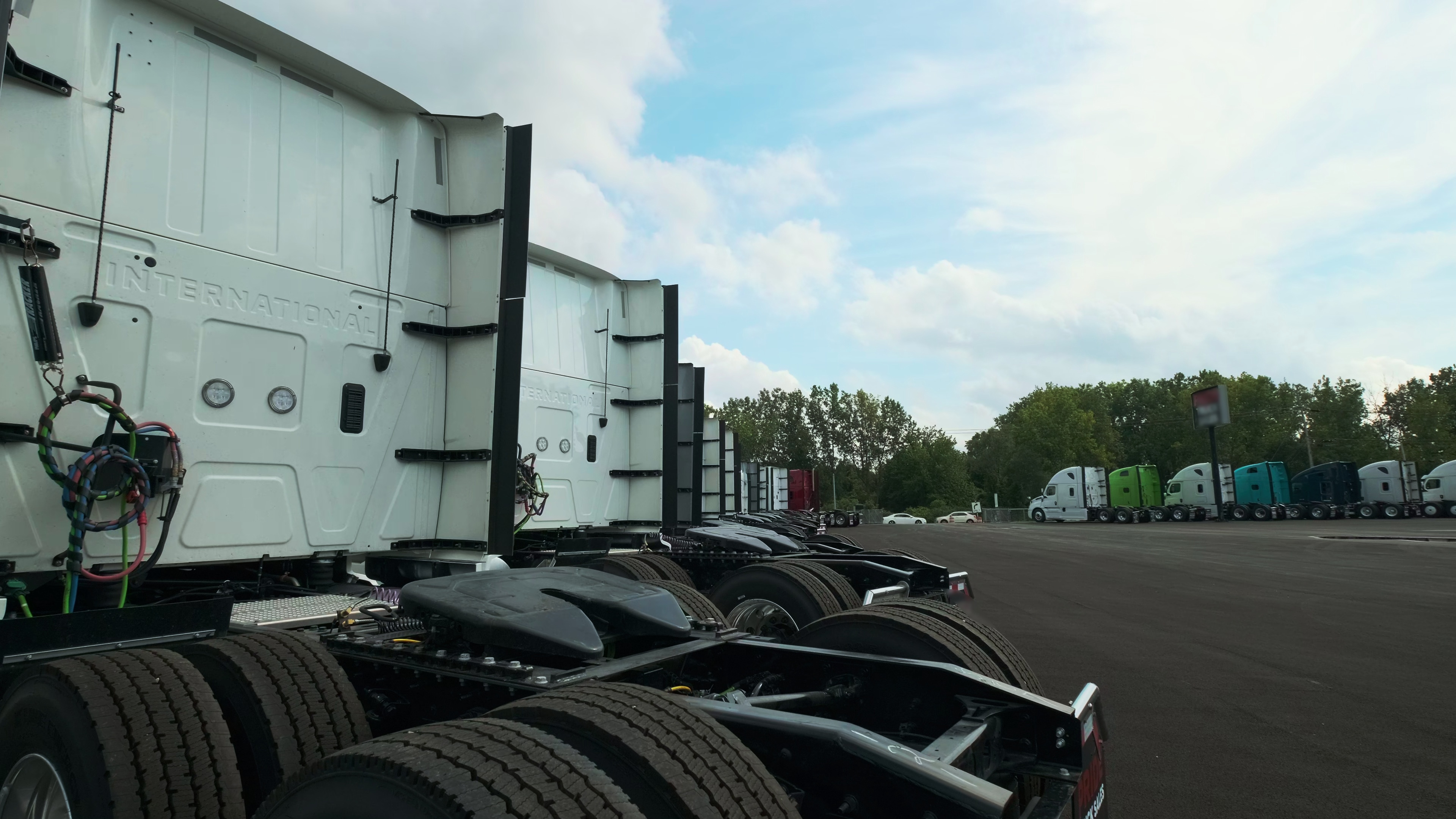
The Rotation Schedule: When and Why
For Class 8 over-the-road tractors, tire rotation should occur every 25,000 to 35,000 miles depending on application, trailer type, and route profile. International’s truck maintenance guidelines recommend aligning rotation intervals with scheduled PM service intervals rather than treating them as separate events — combining rotation with a PM-A or PM-B service eliminates the scheduling friction that causes rotations to be skipped. Drive axle positions wear faster than trailer positions in most OTR applications; a rotation pattern that moves drive axle tires to trailer service positions periodically balances wear across the full tire inventory and extends average casing life for retreading.
Retreading is the cost lever most small operators underuse. A quality retread on a sound casing costs $150 to $250 — roughly 40 to 60 percent of a new budget tire’s cost — and delivers equivalent service life in standard OTR applications. The prerequisite is casing integrity, which requires catching tires before they are driven into sidewall damage or casing separation. Rotation and tread measurement programs protect casing value; reactive replacement programs burn it.
“Fleets implementing comprehensive tire management programs — consistent inflation, timely rotation, proper alignment, and three-point tread measurement at every PM — consistently reduce total tire costs by 25 to 40 percent compared to reactive replacement practices.”
— Heavy Vehicle Inspection Commercial Tire Maintenance Analysis
The 80,000-Mile Alignment Window
Professional alignment checks should be performed every 80,000 to 100,000 miles under normal operating conditions, and immediately after any significant impact event — pothole strikes, curb contact, or off-road excursions. Misalignment’s primary cost is invisible: it manifests as inner or outer shoulder wear that accelerates tire consumption without producing a blowout or obvious handling symptom. By the time steer tire feathering or cup wear is visible to the naked eye during a pre-trip, significant tire life has already been consumed.
An alignment check at a qualified heavy truck shop typically costs $150 to $300 per axle, including adjustment. Fleet Owner’s fleet maintenance data consistently shows that carriers who maintain alignment discipline recover $8 to $12 in tire cost savings for every $1 spent on alignment service — making it one of the highest-ROI maintenance expenditures on the truck. Steer axle alignment is the priority; even minor toe misalignment at the steer axle generates significantly accelerated shoulder wear across the full steer tire set.
The Three-Point Measurement Standard
Every tire on every axle should be measured at three points — inner shoulder, center rib, and outer shoulder — at each PM service interval. Record the readings in a tire log, not just in memory. The pattern across readings reveals the root cause of irregular wear: outer shoulder wear points to overinflation or positive camber issues; inner shoulder wear points to underinflation or negative camber; center-only wear points to chronic overinflation; cup wear points to shock absorber or balance issues. Each pattern has a specific mechanical corrective action. Without the three-point data, corrective action is guesswork.
- Check tire inflation at every pre-trip, not just at fuel stops. Cold PSI readings are the accurate baseline — hot tire readings after highway miles overstate actual inflation by 10 to 15 PSI and should not be used to set pressure.
- Record three-point tread depth measurements at every PM service and log them by tire position. Patterns across two or three consecutive PM intervals reveal alignment and inflation issues early enough to correct them before they consume significant tire life.
- Schedule alignment checks at 80,000-mile intervals and immediately after any impact event. Do not wait for visible shoulder wear to indicate an alignment problem — by that point, thousands of dollars in tire wear have already occurred.
- Combine rotation with PM-A or PM-B service intervals. Stand-alone rotation appointments create scheduling friction that causes rotations to be skipped. Bundling rotation with PM service makes it automatic.
- Evaluate every pulled tire for retread eligibility before writing it off. A sound casing at retread depth saves $150 to $250 per position compared to a new replacement tire and delivers equivalent service life in OTR applications.

Building the Program Before International Roadcheck
International Roadcheck runs May 12–14, 2026, and CVSA officers will be conducting thorough roadside inspections across North America. Tires are among the most frequently cited out-of-service categories during Roadcheck events — tread depth violations, inflation issues, and visible sidewall damage are inspected closely. Any carrier whose tires are not in documented compliance heading into May 12 is carrying avoidable OOS exposure during one of the highest-enforcement weeks of the year. Building a tire audit into your pre-Roadcheck checklist, alongside brake stroke and cargo securement reviews, closes the most common inspection failure categories before the inspection occurs. The 25 to 40 percent lifetime cost savings from a structured tire program are compelling on their own — the Roadcheck enforcement context makes implementing that program this week urgent.