

If you’re working as a freight dispatcher in the U.S., there’s a shift happening that many haven’t acknowledged yet: you’re not just competing with local firms. You’re also competing with dispatching operations halfway around the world.
- Overseas dispatchers undercut U.S. prices using lower labor costs and competitive service, squeezing domestic margins.
- Trust and perception still favor U.S. dispatchers, but that advantage is shrinking as overseas professionalism rises.
- More firms competing for a static carrier pool means your share shrinks unless you strongly differentiate.
- Specialize, build relationships, and showcase U.S. credibility to compete on service, not just price.
- Invest in niche expertise, branding, and strategic services to become indispensable as markets tighten.
Let’s talk about how that changes the game — and why it may mean fewer accessible carriers for you in the years ahead.
The Overseas Factor That Changed the Landscape
It wasn’t long ago that most U.S. carriers preferred domestic dispatch services. Same time zone. Same culture. Easier communication. But thanks to technology, globalization, and cost pressures, a growing number of dispatch services are being operated from Eastern Europe, South Asia, and beyond.
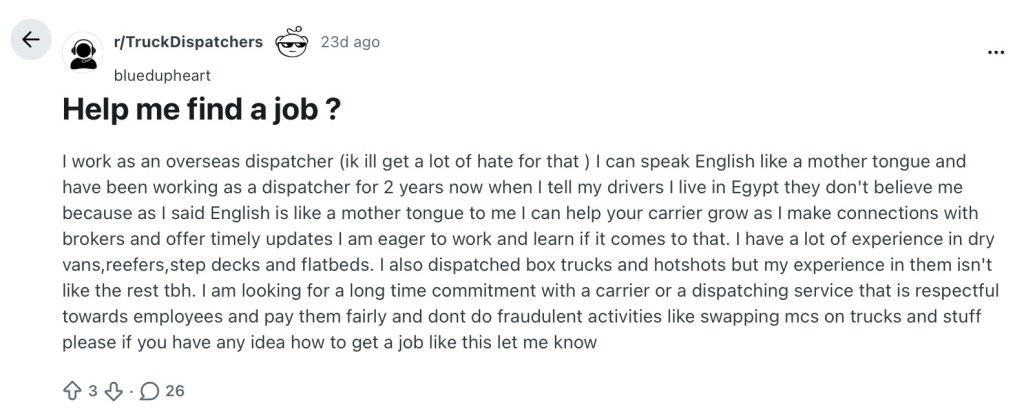
From Reddit threads:
“It is not a secret that dispatchers actually are not in US … Half, and I mean half of the dispatchers you call are overseas.”
“What do brokers think about foreign dispatchers? … Every dispatcher has a super Balkan name.”
“Sole Truck Dispatcher from Pakistan. … Should I learn to be a sole truck dispatcher as a part time job?”
The economic equation is simple: if someone overseas can offer competitive rates, speak serviceable English, leverage cheaper labor cost, and handle load board/bookings/driver updates, then U.S.-based dispatch services are squeezed out of that particular deal.
So what does that actually mean for you, sitting in the U.S., trying to grow a carrier base?
Why U.S. Dispatchers Might Have Fewer Carriers to Work With
1. Price Undercutting & Margin Pressure
When an overseas service can dispatch a truck for a portion of what a U.S. firm charges — because they have lower overhead — carriers may gravitate toward the lowest cost path. That means you might have to fight harder, spend more on marketing, and prove value beyond price to win the same carrier.
2. Perception & Trust Issues Too
While cost is one side, trust is the other. Many carriers value local presence, faster response, time-zone alignment, and cultural/linguistic familiarity. But if overseas dispatch services become more professional and brokers get used to them, the U.S. advantage shrinks.
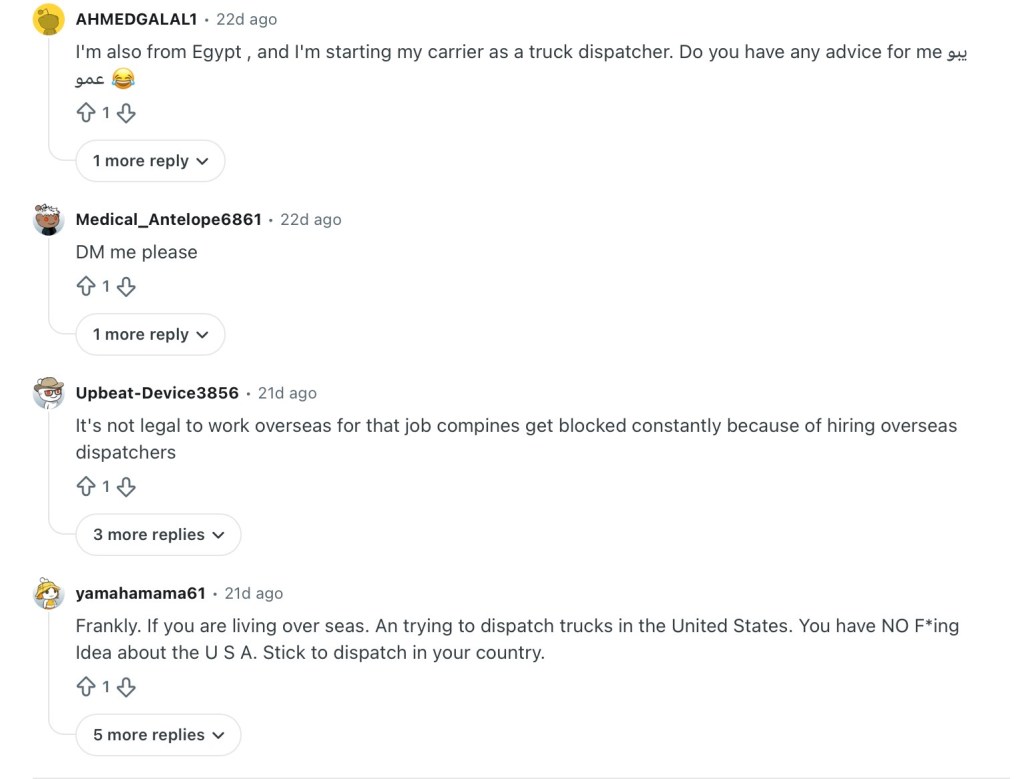
One driver on Reddit wrote:
“Let me guess they Ukrainians? … how can you do a good job from Europe? … The fact that you think it’s the same shows you don’t understand the majority of Americans.”
That sentiment shows there is still a preference for U.S.-based service, but it also shows the barrier to entry for overseas firms is getting smaller.
3. Carrier Pool Doesn’t Grow — It Just Gets Divided
If the total number of carriers looking for dispatch services stays the same (or shrinks slightly), but more firms (domestic + overseas) are competing for them, that means your accessible share of the pie gets smaller unless you differentiate strongly.
4. Course & Training Saturation
More people see dispatching as a remote, global opportunity. Reddit posts show many aspiring dispatchers overseas asking for how to break in, even without U.S. experience. That means more competition overall — even if much of it might be lower quality, it’s still part of the market dynamics.
What This Means For You (and What You Should Do)
Okay — so it’s not hopeless. In fact, this shift highlights which dispatchers will thrive and which will struggle. Here’s how to turn this “competition across the pond” into your edge.
A. Differentiate your value not just by cost, but by service.
- Local time zone, faster driver check-in/updates. More service offerings.
- Stronger U.S. culture, regulatory awareness, sameday handling of issues.
- Brokers and carriers appreciate reliability — you can lean into that.
B. Build genuine relationships with carriers.
Trust matters. If carriers feel you’re just a transaction, they’ll shop elsewhere whenever a cheaper option shows up.
Reach out to carriers proactively. Understand their equipment, lanes, pain points. Talk about what YOU bring, not just the lowest rate you can offer.
C. Become a niche expert.
If the general pool is crowded with many services, specialize. E.g., you focus on flatbed oversize, or reefer produce out of the Southeast, or regional Southeast-Midwest dry van. The narrower you define your target, the less you compete on price and more you compete on expertise.
D. Invest in your brand & credibility.
Overseas services may undercut on price, but they often don’t (yet) match on perceived credibility. Build your U.S. based identity, case studies of successful shipments, driver testimonials, broker reviews. That builds trust and often allows you to hold stronger margins.
E. Monitor market shifts and capacity.
As markets tighten and carriers exit, the value of good dispatchers rises. When carrier demand is higher than supply, quality service becomes the key differentiator, not just cost. Be positioned for that moment.
Forecast: What Happens in the Next 12–24 Months
Let’s be realistic about what’s ahead:
- Outsourcing of dispatch services will continue to be scrutinized especially with crackdowns here in the US. Tech (like remote dashboards, load-board access, VoIP) lowers barriers further.
- Carriers and brokers will start to differentiate between “just dispatching” and “strategic dispatching” — those who offer analytics, real time tracking, driver retention support will stand out.
- U.S.-based dispatchers who lean solely on low cost will struggle. But those who lean on high service, specialization, and rapport will gain.
- The “carrier pool” might tighten (especially if small carriers exit due to cost pressures), so the value of each carrier relationship increases.
- In that environment, being the local, responsive, strategic partner will trump being the cheap backup.
Why You’re Not Competing Only Locally Anymore
It’s important to shift mindset: your competition isn’t just the other dispatcher across town — it may be a service in Belgrade or Dhaka.
And because freight is global, standards are becoming global too. Communication, tech, load boards — all accessible globally.
But here’s the kicker: your advantage remains your U.S.-centric presence if you lean into it. So don’t view overseas services as a threat only — view them as indicators of where the market is going, and use that to raise your game.
Final Word
Yes — as a U.S. dispatcher, you might have fewer carriers to call on than you think because competition spans the globe.
That sounds scary, but it doesn’t have to be.
It just means you must play a different game.
Better service, deeper relationships, sharper specialization.
When you stop thinking of carriers as “just another carrier” and start thinking of them as partners, you stop competing for the cheapest deal and start being the smartest option.
Because when the competition is global, your edge isn’t just being local — it’s being irreplaceable.