If a Class 8 truck is going to fail a Level I inspection during the May 12-14 Roadcheck, the brake system is the single most likely place it will happen. Brake violations alone accounted for more than 40 percent of all vehicle violations in 2025 inspections per CVSA’s Roadcheck statistics, and CVSA flagged tractor protection, supply, and anti-bleed-back valves as a 2026 inspection emphasis. The single most common defect at roadside is excessive pushrod stroke — an instant out-of-service condition under 49 CFR 393.47, a CSA severity-weighted citation under the 2026 framework, and a problem any owner-operator can find before Tuesday with 90 minutes and a tape measure.
Why Brakes Are Still the Number One Vehicle OOS Category
Air brake systems on Class 8 tractors and trailers carry roughly 30 individual moving components per axle that all have to perform within a narrow tolerance band. The slack adjusters wear, the lining wears, the air dryer kicks oil into the system, the diaphragms in the brake chambers fatigue, and the s-cam shaft develops a slight roll. Any one of those wear paths walks the pushrod stroke past its legal limit. CVSA’s pushrod stroke brochure describes the inspection as a 90-100 PSI applied-stroke measurement: charge the system, set parking brakes, mark the pushrod at the chamber face, then have a partner depress the brake pedal while you measure how far the pushrod travels.

Pushrod Stroke Limits by Chamber Type
The chamber type is stamped on the chamber housing — if you can’t read it, you can’t measure it. Common Class 8 chamber sizes and their maximum allowable applied strokes per applied stroke reference standards:
- Type 16: 1 3/4 inches (standard); 2 inches (Type 16LS long stroke)
- Type 20: 1 3/4 inches (standard); 2 inches (Type 20LS long stroke)
- Type 24: 1 3/4 inches (standard); 2 inches (Type 24L long stroke); 2 1/2 inches (Type 24LS extra-long stroke)
- Type 30: 2 inches (standard); 2 1/2 inches (Type 30LS long stroke)
- Type 36: 2 1/4 inches (standard); 3 inches (Type 36LS long stroke)
Twenty percent of brakes out of adjustment on a single vehicle, or any single brake on a steer axle past its limit, is automatic out-of-service. Pull the chamber type, mark the pushrod, measure with the brake released, measure again at 90-100 PSI applied. The difference is your applied stroke.

The single most common brake adjustment issue at roadside is excessive pushrod stroke. Exceeding the limit is an automatic OOS.
The Three Valves CVSA Flagged for 2026
CVSA’s 2026 inspection focus calls out three valves that get inspector attention this year because they’re routinely missed in pre-trip:
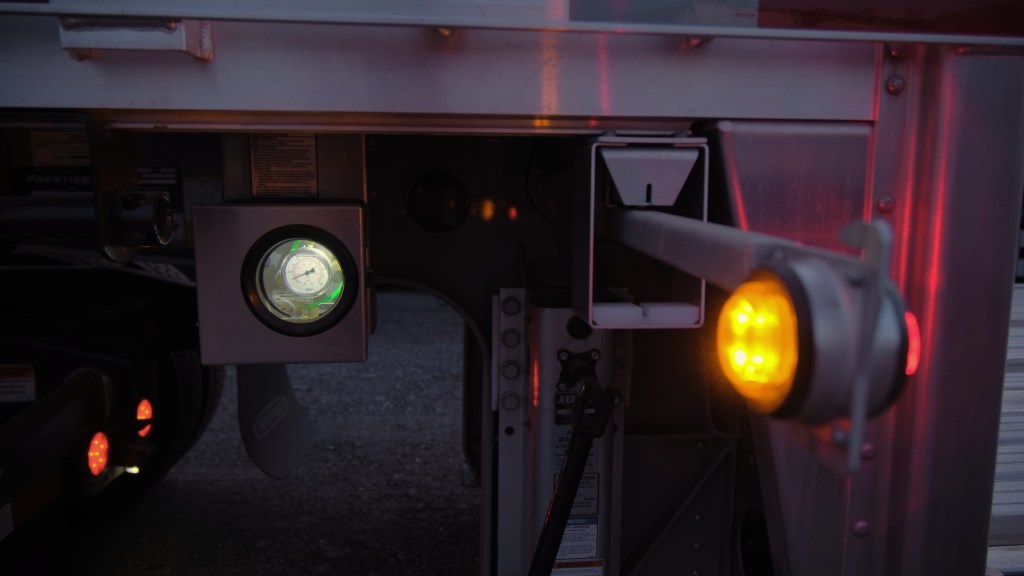
- Tractor protection valve: Sits between the tractor and trailer air supply. Test by charging the system, then disconnecting the trailer supply line at the gladhand — the tractor protection valve should close and the trailer supply should drop to zero PSI. If it doesn’t close cleanly, replace.
- Supply valve (red knob): Should pop out automatically between 20-40 PSI when system pressure drops. Drain a tank, watch the gauge; if the knob doesn’t pop within spec, the inspector will. Approximate replacement cost: $35-90 plus 0.5 hour labor.
- Anti-bleed-back (one-way) check valves: Located in the supply lines to prevent reverse air flow when one tank loses pressure. Failure is invisible until system pressure drops uneven across tanks. Spring-loaded check valves are $15-40 each.
The 90-Minute Pre-Roadcheck Brake Check
- Minute 0-15: Charge the system to governor cut-out (typically 120-140 PSI). Listen for the air-dryer purge cycle. Drain each air tank — clear water means the dryer is doing its job; oily milky discharge means the dryer cartridge is past due (typical interval 12 months/120,000 miles, $150-300 cartridge).
- Minute 15-45: Walk every brake chamber. Read the chamber type, set chocks, mark the pushrod, apply 90-100 PSI, measure applied stroke against the chart above. Document each axle.
- Minute 45-60: Service brake test. Apply and release at 90 PSI ten times rapidly — the system should not lose more than 3 PSI per minute on a single-vehicle test or 4 PSI per minute on a tractor-trailer test (per 49 CFR 396 Appendix A). Anything faster is an air-leak hunt.
- Minute 60-75: Check the three CVSA-flagged valves — tractor protection, supply, anti-bleed-back. Replace any that don’t pass the gladhand and pop-out tests.
- Minute 75-90: Lining inspection. Pull the inspection plug or use a flashlight on the lining edge. Less than 1/4 inch on disc brakes or less than 5/16 inch on drum brakes is replacement time, not Roadcheck-week time.

Cost Math: $400 Now vs $4,000 Later
A pre-Roadcheck brake walk-down at an independent shop is typically $200-400 of labor depending on whether anything needs to come apart. Catching one out-of-adjustment chamber and replacing one supply valve at home base is roughly $150-300 in parts and 1-2 hours of labor. The same defects discovered at a roadside scale during the inspection blitz produce a Level I OOS, a CSA severity-weighted point under the 2026 CSA scoring overhaul, an emergency mobile repair bill that runs $400-1,200 minimum, lost revenue on the load, and a customer-facing service failure. The math has been the same for a decade: brake maintenance is the cheapest insurance an owner-operator can buy. Class 8 trucks rolling clean into Tuesday are the trucks that earn through Friday — and the trucks that don’t will be reading Overdrive’s OOS reports Wednesday morning instead of running.