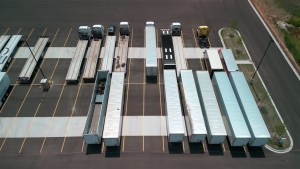

May 2026 produced three autonomous trucking milestones in 10 days, all from Aurora Innovation — and together they represent the most concentrated deployment data the Class 8 driverless industry has ever put on the board in a single month. On May 6, Aurora and McLane Company announced driverless commercial operations between Dallas and Houston. In the same week, Aurora validated the 1,000-mile Fort Worth–Phoenix corridor and tripled its driverless network from roughly three routes to 10. The company now has over 200 driverless trucks committed through Q3 2026. Here is the full data read for independent carriers who need to understand what this deployment actually means — and what it does not mean yet.
The McLane Partnership: What Driverless Commercial Operations Actually Look Like in Practice
The Aurora-McLane announcement on May 6 is the most commercially significant autonomous trucking partnership of the year because McLane is not a pilot customer — it is one of the largest private truck fleets in the United States, a Berkshire Hathaway subsidiary, and a company that services restaurant chains across the country. The partnership transitions a multi-year supervised autonomy pilot into driverless commercial operations on the Dallas-to-Houston route, approximately 240 miles. TechCrunch’s coverage of the announcement notes that the companies logged over 280,000 autonomous miles and 1,400 loads during the pilot phase, with zero Aurora Driver-attributed collisions.
The operational structure is worth understanding in detail, because it differs from full driverless deployment in one important way: there is still a human “observer” in the cab on current McLane routes. The observer does not operate the vehicle — the Aurora Driver is fully responsible for all driving tasks including pulling over to a safe location if required — but OEM Paccar has requested the observers remain in the cab on trucks running its hardware. According to CNBC’s reporting, the long-haul autonomous segment hands off to a McLane driver for local delivery to restaurant customers, with the handoff occurring at Aurora terminals in Dallas and Houston. This is a meaningful operational model for distribution networks but limits the full HOS efficiency advantage of driverless operation to the long-haul segment only.

The 1,000-Mile Fort Worth–Phoenix Corridor: Why This Is the Most Important Autonomous Data Point of 2026
The validation of the Fort Worth–Phoenix lane — approximately 1,000 miles — is categorically different from the Dallas-Houston operation. According to Heavy Duty Trucking’s coverage, this route “extends well beyond current Hours of Service limitations for human truckers.” A single human driver running legal HOS cannot complete this lane in a single continuous operation — it requires either a team driver configuration or a relay handoff. The Aurora Driver has no HOS limitation. Without mandatory rest breaks, Aurora’s published data suggests the driverless system can effectively cut transit times nearly in half compared to a single-driver operation.
Aurora now has an interconnected Sun Belt driverless corridor covering five routes: Dallas–Houston, Fort Worth–El Paso, El Paso–Phoenix, Fort Worth–Phoenix, and Dallas–Laredo. CCJ Digital’s analysis of the network expansion notes that this creates a continuous autonomous freight corridor from the Gulf Coast to the Southwest — the most commercially active freight geography in the United States. All of Aurora’s commercial truck capacity is committed through Q3 2026, per the company’s investor relations disclosures, and the company plans to have more than 200 driverless trucks running by year-end.
“With 250,000 driverless miles and zero Aurora Driver-attributed collisions, Aurora is laying the groundwork for scale. The 1,000-mile Fort Worth–Phoenix route extends well beyond current Hours of Service limitations for human truckers — and by operating without mandatory rest breaks, the Aurora Driver can effectively cut transit times nearly in half.”
Aurora Innovation investor relations, May 2026
What the Aurora Build-Out Means for Independent Carriers: A Realistic Assessment
The data from Aurora’s May 2026 announcements is significant, but independent carriers should read it with clear-eyed specificity rather than generalized concern or dismissal. The lanes Aurora is operating — Texas Sun Belt corridors, distribution hub-to-hub movements, high-volume repeat routes with predictable conditions — are precisely the routes that are most favorable to autonomous operation. They are not, for now, the irregular routes, multistate agricultural hauls, flatbed loads, or carrier-to-customer final-mile deliveries that make up the majority of independent owner-operator work.
- 200+ driverless trucks by end of 2026 on 10 routes: Aurora’s committed capacity through Q3 covers specific Sun Belt lanes for committed shippers like McLane and Detmar. Independent carriers are not competing with Aurora for these loads — these are long-term contracted movements, not spot board freight.
- 1,000-mile corridor efficiency advantage is real and material: On routes where a single human driver requires a rest break or a team configuration, the driverless system’s HOS advantage is roughly a half-day per load. For shippers with time-sensitive supply chains, this is meaningful. Watch for large shippers on these lanes to begin structuring contract terms around guaranteed overnight delivery — a service level that human single-driver operations cannot consistently match.
- The observer model limits full deployment speed: As long as OEMs like Paccar require in-cab observers, Aurora’s per-truck cost advantage over human-driven operations is constrained by the observer’s salary. Full cost parity — the point at which driverless operation is cheaper per load than a human driver — requires the observer to come out of the cab. That transition is a technical and regulatory process, not an imminent switch.
- Next-generation Aurora hardware arrives Q2 2026: Aurora’s second-generation Aurora Driver hardware, designed to last over 1 million miles and cut per-truck system cost by 50%, is scheduled for Q2 2026 deployment on the International LT Series. This is the hardware generation that makes the economics of full fleet-scale driverless operation viable. Monitor Q2 deployment volume as the leading indicator of how quickly Aurora moves toward 200+ units.

What to Watch Through Q3 2026
The next 90 days will be the most data-rich period in autonomous trucking history. Aurora’s 200-truck deployment target requires roughly 150 net new driverless trucks on the road between now and December 31. The company’s Q2 2026 investor updates — expected in mid-July — will show whether the second-generation hardware rollout is on schedule and whether the McLane and Detmar contracts are generating the operational volume Aurora’s financial model requires. For independent carriers running Sun Belt lanes, the key signal to watch is whether large shippers in those corridors begin issuing RFPs that include driverless-capable service requirements as a bid criterion — that is the structural market signal that would indicate autonomous freight is beginning to compete directly with the carrier base, rather than complementing it. Until that signal appears, the May 2026 Aurora announcements represent a remarkable technical and commercial milestone for the autonomous industry — without yet representing a direct competitive threat to the independent carrier moving irregular freight across the broader U.S. network.