
The Trap of the “Fast Track”
The dream of the open road is a powerful one. For many, a Commercial Driver’s License (CDL) represents a path to financial freedom, travel, and a stable career. However, because the demand for drivers is so high, a predatory type of business has emerged: the CDL Mill.
- Verify the school is listed on the FMCSA Training Provider Registry before paying any tuition.
- Avoid programs promising three-day training; real CDL training takes weeks with documented behind-the-wheel hours.
- Inspect equipment and training practices: real-world driving in full-size, well maintained trucks beats test-only coaching.
A CDL mill is a school that treats students like products on an assembly line. Their goal isn’t to make you a safe, professional driver; it’s to get your tuition money and push you through the DMV test as fast as possible. In 2026, the Department of Transportation (DOT) has begun a massive crackdown on these “sham” schools, but many still operate in the shadows.
If you choose the wrong school, you could end up with a license but no job—or worse, a license that gets revoked when the school is shut down for fraud. Here is how to spot the red flags before you sign the dotted line.
Red Flag #1: The “Three-Day” Promise
In the trucking world, speed is usually a good thing—except when it comes to your education. Professional truck driving is a complex skill that takes weeks, not days, to master.
- The Reality: Federal Entry-Level Driver Training (ELDT) laws require a comprehensive curriculum that includes 31 specific theory topics and documented behind-the-wheel proficiency.
- The Warning Sign: If a school tells you that you can be “road-ready” in three days or a single weekend, they are likely falsifying your training hours. A legitimate program usually lasts between three to eight weeks. If the timeline seems too good to be true, it’s a mill.
Red Flag #2: Missing from the “TPR”
In 2026, there is one “gold standard” for legitimacy: the Training Provider Registry (TPR). This is a federal database managed by the FMCSA (Federal Motor Carrier Safety Administration).
- The Reality: By law, a DMV cannot even allow you to take your CDL skills test unless your training was provided by a school listed on the TPR.
- The Warning Sign: If a school is not on the registry—or if they give you a vague excuse about why they aren’t listed yet—walk away. Recently, Secretary Sean Duffy purged over 550 schools from this list for non-compliance. Always verify a school’s status yourself at tpr.fmcsa.dot.gov before paying a dime.
Red Flag #3: “Teaching the Test” vs. Teaching the Road
There is a big difference between knowing how to pass a 15-minute DMV exam and knowing how to drive a 40-ton rig through a crowded city.
- The Reality: A good school teaches you about “Real World” scenarios: how to manage your electronic logging device (ELD), how to handle mountain grades, and how to perform a proper pre-trip inspection that will pass a roadside DOT officer’s scrutiny.
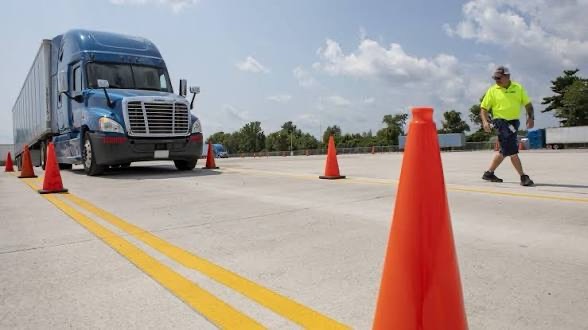
- The Warning Sign: CDL mills often use “test-focused” training. They might have you practice only the specific backing maneuver used at the local DMV, or they might use undersized trucks and “short” trailers that are easier to park but aren’t what you’ll actually drive for work. If you aren’t spending significant time on public roads in a full-sized tractor-trailer, you aren’t being trained—you’re being coached.
Red Flag #4: The Equipment “Museum”
Take a look at the yard. The trucks a school uses tell you everything you need to know about their commitment to your future.
- The Reality: Modern trucking in 2026 relies on automated manual transmissions, advanced collision-avoidance systems, and digital dashboards.
- The Warning Sign: If the fleet looks like it belongs in a junkyard—engines leaking oil, tires with no tread, or transmissions that grind with every shift—the school is cutting corners. Furthermore, if they only train on automatic transmissions, you will receive an “E” restriction on your license, preventing you from driving a manual truck. A quality school offers a variety of well-maintained equipment so you are prepared for any job.
Red Flag #5: The “Guaranteed Job” Gimmick
“Everyone gets hired! Guaranteed $100k starting salary!” These are common slogans used by CDL mills to lure in students.
- The Reality: No school can “guarantee” a job because they don’t control the hiring departments of trucking companies. Reputable carriers (like Schneider, Swift, or specialized flatbed companies) perform their own background checks, drug tests, and “road tests.”
- The Warning Sign: If a school claims to have a “guaranteed” job but won’t name the specific carriers they work with, be wary. Legit schools have Job Placement Assistance, where they host recruiters from multiple companies and help you build a resume. They don’t make promises they can’t keep.
Red Flag #6: High-Pressure Sales Tactics
A reputable school is an educational institution; a CDL mill is a sales office.
- The Reality: Deciding to become a truck driver is a life-changing move. You should have time to tour the facility, talk to current students, and review the refund policy.
- The Warning Sign: If a recruiter tells you that you must “pay a deposit today or lose your spot,” or if they are unwilling to give you a written breakdown of tuition and fees, they are trying to “lock you in” before you can do your research.
The “Paper Driver” Danger
The industry has a nickname for people who graduate from CDL mills: “Paper Drivers.” These are people who have the plastic license in their wallet but have zero confidence or skill behind the wheel.
When a “paper driver” shows up at a reputable company for a job interview, they are usually “washed out” (failed) during the company’s internal road test. This leaves the student with thousands of dollars in debt and a license they can’t actually use. By spotting the signs of a mill early, you ensure that your investment leads to a real career, not just a piece of paper.
Conclusion: Do Your Homework
In the new era of trucking oversight led by Secretary Duffy, the “easy way” is becoming the “dangerous way.” To protect yourself, always:
- Visit in person: Don’t just look at a website. Look at the trucks and the student-to-instructor ratio.
- Ask about “Seat Time”: How many hours will you personally spend behind the wheel?
- Check the Reviews: Look for reviews from graduates who have been on the road for six months, not just people who just passed the test.
Choosing a quality school might take a little longer and cost a little more, but it is the only way to ensure you have a long, safe, and profitable career in the driver’s seat.