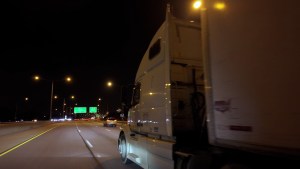

The Class 8 electric truck conversation moved this week from “can it haul” to “where can it charge.” Tesla’s first public Megacharger station has gone operational in Ontario, California, and the company has now mapped 66 Megacharger locations across 15 states with a target of 46 stations live by the end of 2027. Texas leads the buildout at 19 proposed sites; California has 17. The 1.2-megawatt cabinet recovers 60 percent of a Tesla Semi’s range in 30 minutes. For independent carriers running the eCascadia-versus-Tesla-Semi decision, the question stops being “will charging exist” and starts being “will charging exist on the lane I run.”
- Tesla's Semi Charging for Business pricing roughly matches Sysco and PepsiCo private-depot rates, easing fleet economics for public charging users.
- Network density targets corridor truck stops with high grid capacity, optimized for 350 to 450 mile loaded regional runs rather than coast-to-coast hauls.
- Independent carriers must weigh duty cycle, charging access, and freight type; charger location on actual lanes now the pivotal question.
- California HVIP vouchers of roughly $120,000 to $150,000 significantly lower Tesla Semi net cost into the upper-diesel purchase range.
- Market remains mixed: Daimler eCascadia leads regional volume; Tesla adds a third serious option, not a market lock.
What Just Went Live in Ontario
The Ontario, California Megacharger station is the first publicly accessible site in the network. Per Electrek’s late-April coverage, the station opened with multiple 1.2-megawatt stalls capable of charging a Tesla Semi from a 20% state-of-charge to 80% in approximately 30 minutes. Tesla also launched a paired commercial product, Semi Charging for Business, which is the company’s pricing and billing program for fleet customers. Fleet Maintenance reported the per-kWh pricing tier structure aligns roughly with the Sysco and PepsiCo private-depot rates that have been guiding eCascadia and JETSI economic models.
The station is the front edge of the network buildout. Tesla’s posted Megacharger rollout map shows 66 locations selected across 15 states, with the densest cluster running along the I-10 / I-40 corridor between Los Angeles and Dallas-Fort Worth. Tesla Oracle’s coverage of the program update confirms the 46-station 2027 target and the 1.7-million-square-foot Nevada production facility that will feed trucks into the network. The actual completion sequence: 12-14 stations operational by year-end 2026, 30+ by mid-2027, 46 by year-end 2027.

The Numbers Independent Carriers Care About
- Tesla Semi Long Range trim: $290,000 sticker, 500-mile rated range, payload class targeted at 82,000 lb gross combined weight, per Clean Trucking.
- Megacharger network plan: 66 mapped locations across 15 states; 46 live by 2027.
- Charging speed: 1.2-megawatt cabinet, 60% range recovery in approximately 30 minutes.
- Production capacity: 50,000 units annual at the Nevada line; 5,000-15,000 deliveries forecast for 2026 by Wall Street analysts.
- California voucher applications: 965 of 1,067 HVIP applications filed between January 2025 and February 2026 were for the Tesla Semi, per Electrive’s reporting.
- Texas leads proposed sites: 19 Megacharger locations in Texas, 17 in California, smaller clusters across Arizona, New Mexico, Tennessee, and the Carolinas.
What the Charging Map Actually Tells Us
The Megacharger map confirms what fleets running NFI’s JETSI depot in Ontario and Sysco’s eCascadia program in Houston have been telegraphing for two years: Class 8 electric is going to scale on regional and dedicated lanes first, not over-the-road. The site density is concentrated where shipper-side charging already exists — Inland Empire, Houston, the Carolinas — and the corridor sites are spaced for the 350-450 mile loaded leg of an existing regional route, not the 1,800-mile cross-country lane. FreightWaves’ framing of 2026’s freight winners aligns: the carriers who win on Class 8 electric will build the schedule around the chargers that exist, not the chargers that should exist.
The competitive picture stays mixed. Daimler’s eCascadia continues to be the volume leader on dedicated regional duty, with the Sysco 800-truck order and NFI’s 50-vehicle JETSI depot proving the operating economics in real-world miles. Volvo’s VNR Electric and the Kenworth K270E hold smaller niches in last-mile and beverage distribution. Hydrogen Class 8 from Hyzon and Hyundai XCIENT remains a 2027-2028 conversation outside California. The Megacharger map does not lock the market for Tesla; it just adds a third real option for independent carriers and large private fleets working on the diesel-replacement decision.
“Texas currently stands out with 19 proposed Megacharger sites — the largest number in any state — while California trails closely with 17. The 1.2-megawatt Megachargers are capable of recovering 60 percent of the battery’s range in just 30 minutes.”
— TeslaNorth, coverage of the first high-volume Semi off the Nevada line
What This Means for the Independent Carrier Decision
For an owner-operator or small fleet running 80,000-mile-a-year trucks, the Class 8 electric math still pivots on three questions, and the Megacharger announcement only changes the second one. The first is the duty cycle — if the truck does not return to the same yard every 36 hours, electric does not pencil yet. The second is charging access — the Megacharger map is the new piece of the puzzle, and corridor lane fits along I-10 east of Los Angeles, the Houston-to-Dallas spine, and the I-40 corridor through Tennessee start looking realistic. The third is the freight type — Class 8 electric drops payload by 4,000-6,000 lb on a 6×4 tractor configuration, which knocks the truck out of bulk-commodity hauling but leaves it whole on dry van and most reefer.
The HVIP Voucher Story Independent Carriers Should Know
The California Hybrid and Zero-Emission Truck and Bus Voucher Incentive Project (HVIP) continues to do most of the heavy lifting on the per-truck purchase math. Clean Trucking’s coverage notes that Tesla Semi vouchers approved through HVIP have been pricing out at $120,000-$150,000 per truck against the $290,000 sticker, taking the effective acquisition cost into the upper-Class-8-diesel range. For independent carriers domiciled in California or Washington with operating ground in California, the HVIP plus the Megacharger network rollout is the first time the Class 8 electric question is closer than “interesting in 2028.” For carriers domiciled in Texas, the HVIP equivalent at the state level is sparse, and the math is closer to a private-depot decision than a public-charging decision.

What to Watch Next
The next data points worth bookmarking are the Q2 Tesla earnings call (typically late July), where the company will publish Semi delivery numbers for the first half; the next round of HVIP voucher announcements expected mid-summer; and the publicly-trackable Megacharger commissioning calendar, which Tesla refreshes monthly. By Labor Day, the question on the desk for any independent carrier eyeing Class 8 electric is going to be “do my actual lanes touch one of the operational Megachargers,” not “is the network theoretical.” That is a 90-day decision window. Pull the lane map, drop the Megacharger overlay, and run the math.