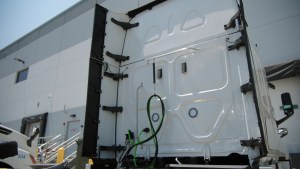
While the headlines chase Tesla’s shifting Semi timeline, the autonomous-freight company quietly logging real paid driverless miles on Texas highways is Kodiak — and it is scaling faster than most dispatchers realize. Kodiak AI is pushing toward a long-haul driverless launch targeted for late 2026, backed by a live commercial route with Roehl Transport and a manufacturing partnership with Bosch. For independent dispatchers running Sun Belt lanes, this is no longer a science-fair demo; it is a competitor for freight that starts and ends in your markets.
The Roehl Route: Real Freight, Real Cadence
The most concrete signal is the Kodiak-Roehl operation. Kodiak AI and Roehl Transport began autonomous freight on a regular Dallas-to-Houston route, with trucks running the Kodiak Driver system on four round-trips per week starting in April 2026. That is not a one-off publicity run — it is a scheduled, repeating lane between two of the busiest freight markets in the country, exactly the kind of dense, straight-shot corridor that autonomy targets first.
The scale numbers back it up. In the first quarter of 2026, Kodiak logged more than 23,500 hours of paid driverless operations, a 120% jump from the end of 2025, and expanded its driverless fleet from 20 trucks to 28 during the quarter. Paid, driverless, and growing at triple digits — those are the three words that should get a dispatcher’s attention.

The Bosch Deal Is the Real Tell
Demos are cheap; manufacturing is hard. Kodiak’s partnership with Bosch to scale its autonomous hardware is the signal that the company is preparing to build driverless systems at volume rather than hand-assemble prototypes. Autonomous trucking has always died in the gap between a working truck and a producible one; a tier-one supplier like Bosch entering the picture is how that gap gets closed. For dispatchers, the takeaway is timing — the industrial pieces required for a real fleet are being put in place now.
Kodiak logged more than 23,500 hours of paid driverless operations in the first quarter of 2026 — a 120% increase from the prior quarter — as it drives toward a long-haul driverless launch targeted for late 2026.
ACT News, on Kodiak’s driverless operations
What It Actually Means for Your Lanes
Autonomy will not take your freight overnight, and it starts narrow. Here is how a working dispatcher should read it right now:
- It targets the middle mile, not the whole trip: Driverless trucks run hub-to-hub on interstate corridors — the messy first and last miles, dock work, and regional freight still need human drivers and dispatchers.
- Sun Belt corridors go first: Texas and the broader Sun Belt lead because of weather, road geometry, and regulation — if your lanes run I-45, I-10, or I-35, you’ll see it soonest.
- The threat is to cheap, long, simple lanes: Straight-shot dry van between major hubs is the most exposed; specialized, high-touch, and regional freight is the most defensible.
- The opportunity is in the handoff: Someone still has to move freight to and from autonomous transfer hubs — position for the short-haul and drayage work autonomy creates around its terminals.
- Watch the launch date, not the hype: A late-2026 driverless launch is the milestone that matters; track whether Kodiak hits it before you assume the timeline.

The Bottom Line for Dispatchers
Kodiak’s progress is a reminder that the autonomous timeline is measured in quarters now, not decades — but also that the near-term winners are the operators who understand exactly which freight is exposed and which is not. Editorial note: with Aurora’s second-generation trucks and Tesla’s Semi timeline already covered in recent iDispatchHub reporting, we focused this week on Kodiak as the freshest distinct development in the space. Keep an eye on the late-2026 driverless launch: if it lands on schedule, the conversation shifts from “if” to “which lanes next” — and the dispatchers who already know their defensible freight will be the ones still standing.